Products · September 25, 2026 · 6 min read · By Surface Labs team
Inside Sims: from a modeled business to a measured result
How Sims models a business, simulates a change across scenarios, plans inside guardrails, confirms it against a control group, and recalibrates.
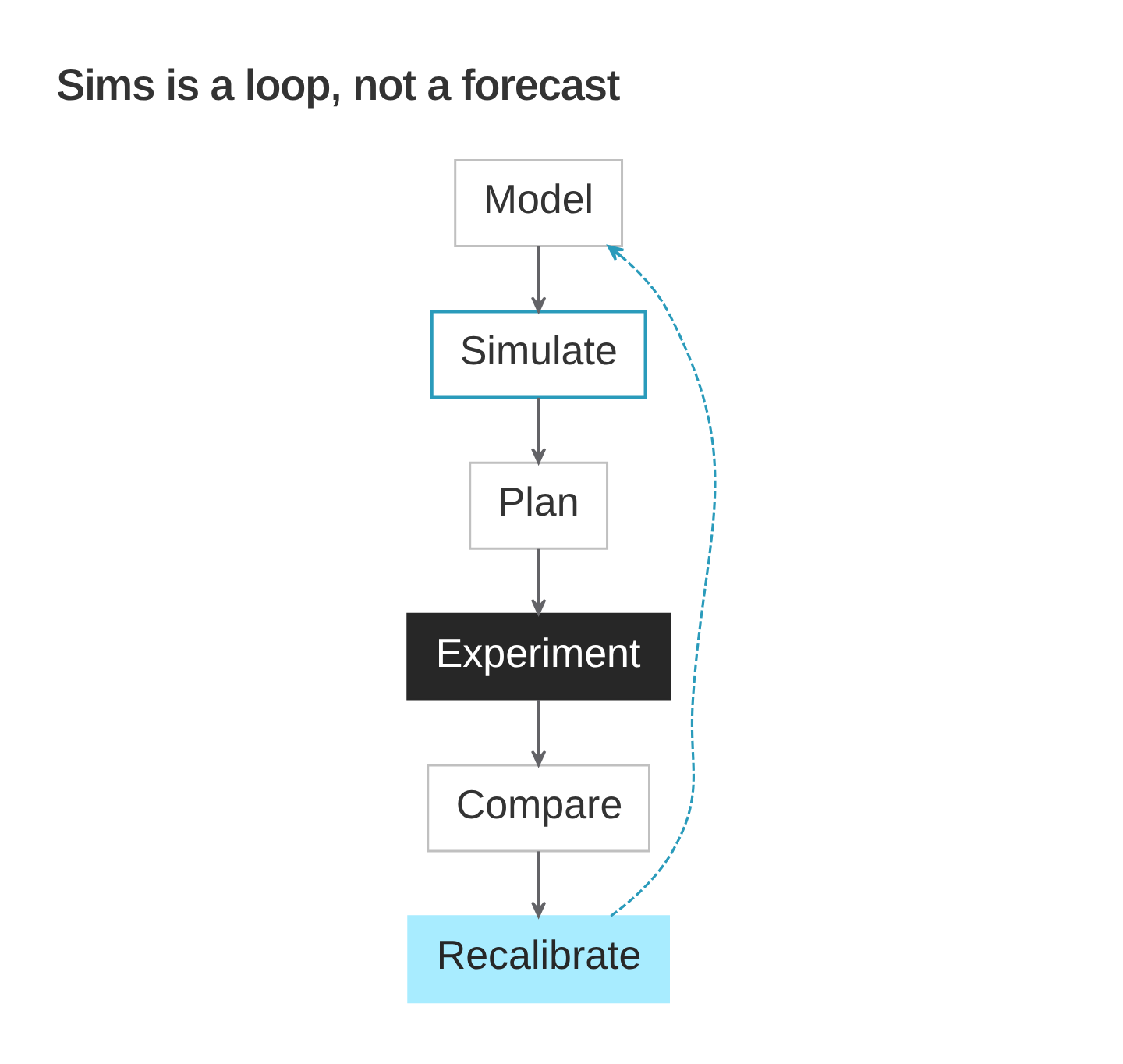
Sims is the modeling and simulation engine for business decisions. It models how a company's go-to-market and back office run, forecasts a change before it ships, confirms it with a live experiment measured against a control group, and recalibrates on the company's own results. Sims covers the whole path: building and testing scenarios, running simulations, and running live experiments.
This post walks through the engine. The statistical background, why simulations mislead and how counterfactuals are estimated, is in Simulating buyers without fooling yourself and Counterfactuals for operators. Here we focus on how the pieces fit in Sims.
One loop, run continuously
Sims is a loop, not a one-off forecast. Each pass brings the model closer to how the business actually behaves.
01 Model the business, modeled from its data in Vault
02 Simulate each change run across many scenarios
03 Plan the best forecast inside the team's guardrails
04 Experiment run the plan on a share of real traffic, against a control group
05 Compare actual results scored against the forecast
06 Recalibrate the model updated where it missed (back to 01)
The important property is that steps 4 to 6 close the loop. A simulator that is never checked against reality drifts. One that is scored against measured outcomes after every experiment, and corrected where it missed, gets more trustworthy with use.
What it models
A business decision touches more than customers. Sims models the people, records and software a decision touches, end to end, in three layers.
Customer behavior. How buyers respond to a change in offer, message, timing or channel: response and conversion curves, segment and cohort mix, seasonality and lag.
System-of-record data. The company's CRM, ERP and billing records, with its own schema and history: pipeline and stage movement, invoices, payables and spend, approval and exception rates.
Software stacks. The tools a workflow runs through, treated as one environment: routing, enrichment and ads, handoffs between systems, and their limits, delays and failures.
The third layer is easy to leave out, and it is often where a change breaks. A routing change that looks good on paper can fail because enrichment runs late or a calendar integration rate limits. Modeling the stack lets Sims ask what breaks, not only what converts.
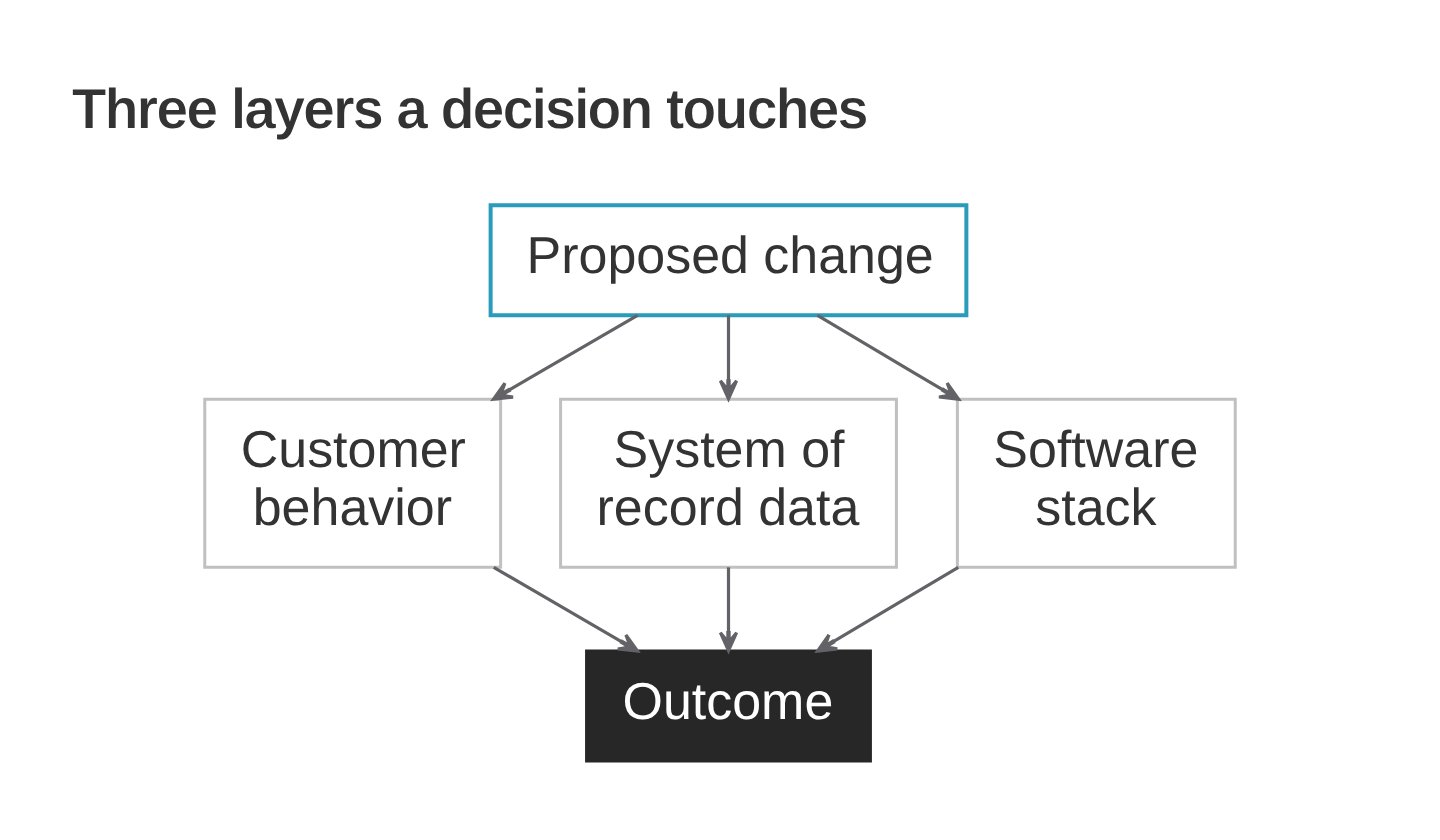
outcome = f( customer_behavior(change, segment, time), records(state at t), stack(limits, delays, failures) )Scenarios
A scenario is one concrete change and the question it should answer. Examples teams test:
- Faster lead follow-up. What happens to booked meetings if reply time drops?
- Shift ad budget. What if part of search spend moves to LinkedIn?
- New pricing or packaging. How would buyers respond before the page changes?
- Shorter forms. Do fewer fields bring better leads, or just more?
- Earlier renewal outreach. Which at-risk accounts respond to an earlier check-in?
- Retire a point tool. What breaks if the job moves into Prism?
Each scenario names the lever and the outcomes to watch. A lead score threshold change, for instance, is judged on meetings, pipeline quality and rep time together, not on meetings alone. Picking the outcomes before simulating is what keeps the result from being chosen after the fact.
Simulations and experiments do different jobs
Sims runs two kinds of runs, and they are not interchangeable.
| Simulations | Experiments | |
|---|---|---|
| Runs on | The model of your business | A share of real traffic, measured against a control group |
| Who sees it | No one outside your team | A test group of real customers |
| Use it to | Rank options and drop weak ones | Confirm the plan before it rolls out |
| Returns | A forecast with confidence bands | Actuals that recalibrate your model |
Simulate to narrow the options. Experiment to confirm the winner. Simulations are cheap and private, so they are the right place to explore many options and discard most of them. Experiments touch real customers and take time, so they are spent only on the options that survived simulation.
A forecast is reported with confidence bands, not a single number, because the decision depends on the spread as much as the center. Two options whose bands overlap heavily are not distinguishable yet, and the honest output is "run an experiment", not a winner.
Planning inside guardrails
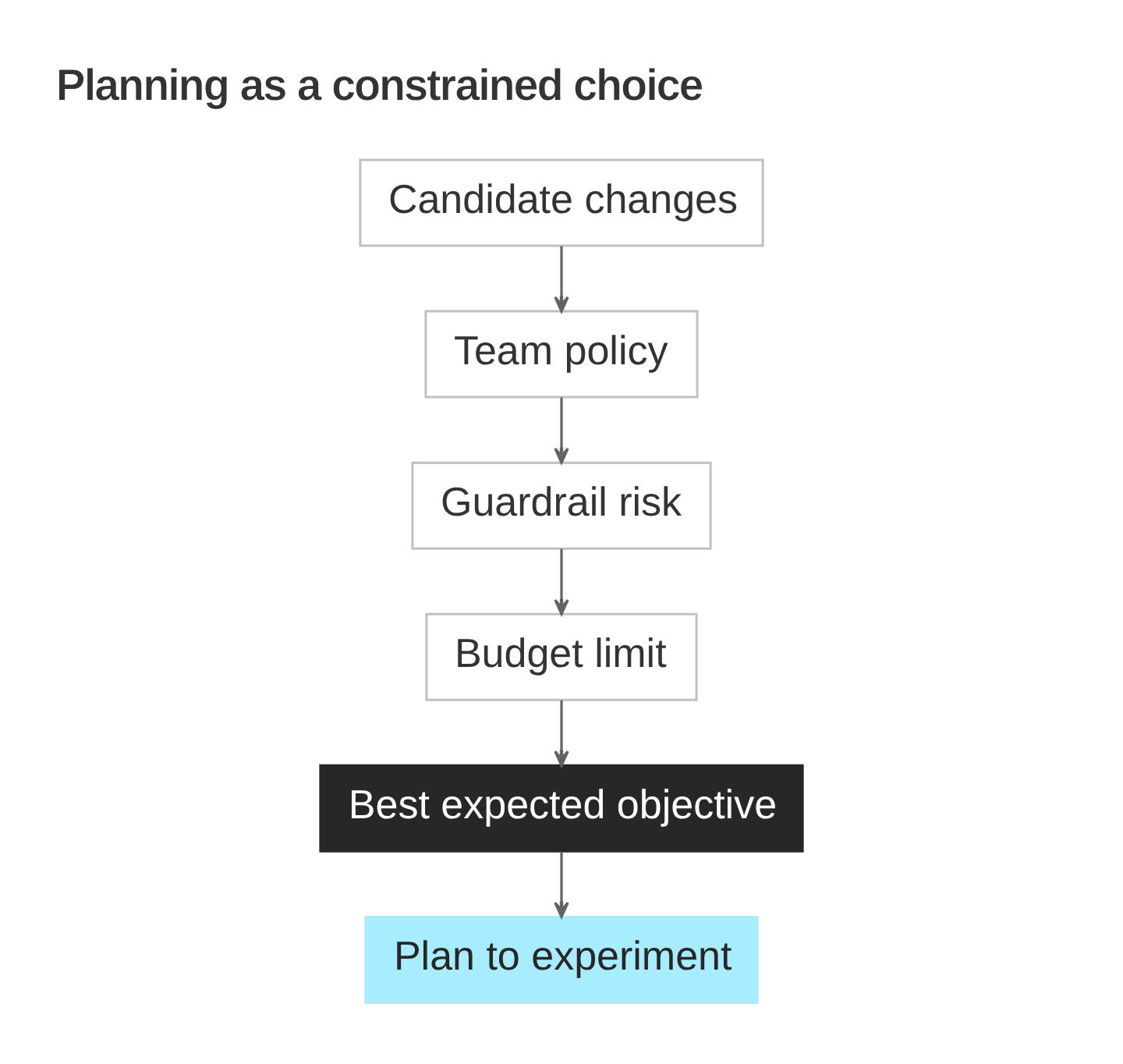
The Plan step picks the best forecast that respects the team's guardrails. One way to write that down is as constrained optimization over the simulated outcomes (a sketch, not the exact formulation):
choose change c from candidates
maximize E[ objective(c) ] e.g. pipeline, margin
subject to P( guardrail_k(c) violated ) <= eps for every guardrail k budget(c) <= budget_limit c is allowed by team policy
Guardrails are things like maximum reply time, minimum margin, rep capacity or a budget ceiling. Writing them as constraints, rather than folding them into one score, means a plan that wins on the objective by breaking a guardrail is never proposed.
Experiments against a control group
The plan then runs on a share of real traffic. The rest is the control group, and the result is the difference between the two. Randomizing at the right unit (person, account or region), sizing the experiment so it can detect a realistic effect, and running it long enough to cover lag are the standard requirements, covered in the counterfactuals post. Rolling out a winning change should follow the same staged discipline as a software release. (Shipping a process change like a software release.)
Compare and recalibrate
When an experiment ends, Sims scores the actual result against the forecast. That comparison has two uses.
The first is the decision: did the change work, and by how much, against the control group.
The second is the model: where did the forecast miss? A forecast that was consistently too optimistic for one segment, or that ignored a lag, is corrected for the next pass. In sketch form:
error_k = actual_k - forecast_k per outcome, per segment
update model parameters where |error_k| is outside the forecast band
store (scenario, forecast, actual, error) in Vault history
Every run is stored in Vault with its inputs and result, so the model's own track record is visible over time. That record is also the raw material for honest write-ups of changes that didn't work. (Postmortems for business changes.)
Your model learns from your results only
Recalibration uses a company's own results to improve that company's model. Surface never uses customer data to train its models or to improve the platform for other customers. (Learning from your data without training on it.)
The takeaway
Sims models customer behavior, system-of-record data and the software stack together, runs a change across many scenarios, plans inside explicit guardrails, confirms the winner with a live experiment against a control group, and recalibrates where the forecast missed. Simulations narrow the options. Experiments confirm the winner. The loop is what makes the model worth trusting.