Research · October 21, 2026 · 5 min read · By Surface Labs team
Postmortems for business changes
Engineering teams write postmortems when systems fail. A template and analysis method for go-to-market changes that don't work, and why we publish it.
When a production system fails, good engineering teams write a postmortem: what happened, why, what the impact was and what will change. The format is blameless, the goal is learning and the document is shared.
When a go-to-market change fails, such as a new offer that lowered conversion, a routing change that slowed response times or a budget shift that cost pipeline, the usual response is quieter. The change is reverted, someone makes a slide, and the team moves on. Six months later a different person proposes the same idea.
Business changes deserve postmortems. This post covers what to write, how to analyze it and why we publish the method.
What counts as a failure
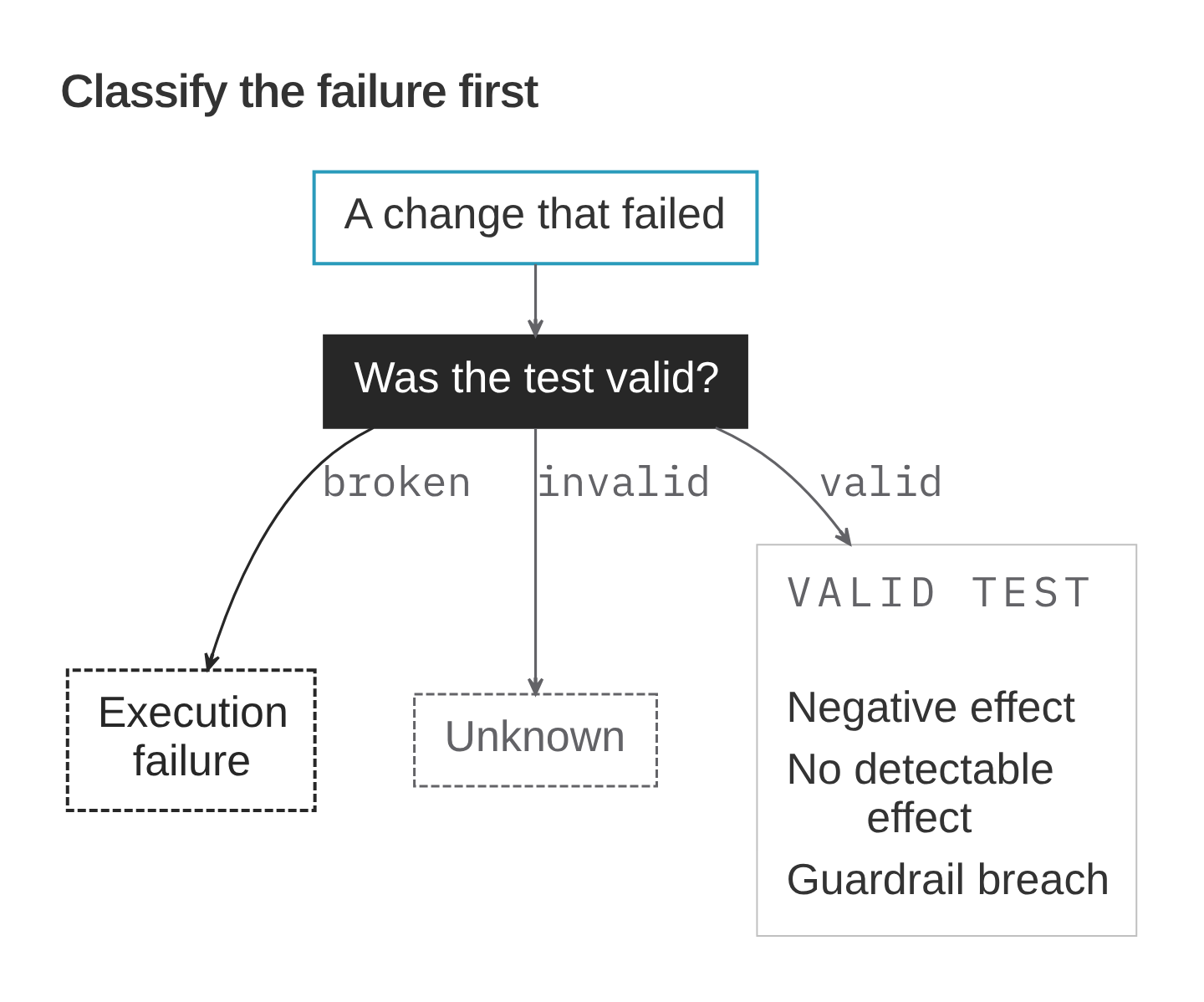
A change "didn't work" in one of four ways, and they need different write-ups:
- Negative effect. The change made the target metric worse against the control group.
- No detectable effect. The change did nothing measurable. Often the most common outcome, and still worth recording.
- Guardrail breach. The target improved but something else got worse: response times, margin, rep workload, unsubscribes.
- Execution failure. The change was not implemented as designed: a rule misfired, a segment was mis-targeted, a field was wrong.
Separating these matters. "The idea was wrong" and "the idea was never actually tested" lead to opposite conclusions.
The template
An illustrative example:
Title: Lower enterprise threshold to 300 employees
Owner: [role]
Dates: ramp start, full exposure, decision
Hypothesis: what we expected, written before launch
Design: unit, control group, exposure, duration, metrics, guardrails
Result: effect estimate with interval, guardrail results
Classification: negative | null | guardrail | execution
Timeline: key events, including anything else that changed
Analysis: why we think it happened, with evidence
What we'd do differently
Follow-ups: concrete actions with owners
The hypothesis and design should be copied from the pre-launch record, not reconstructed after. That is what keeps the postmortem honest.
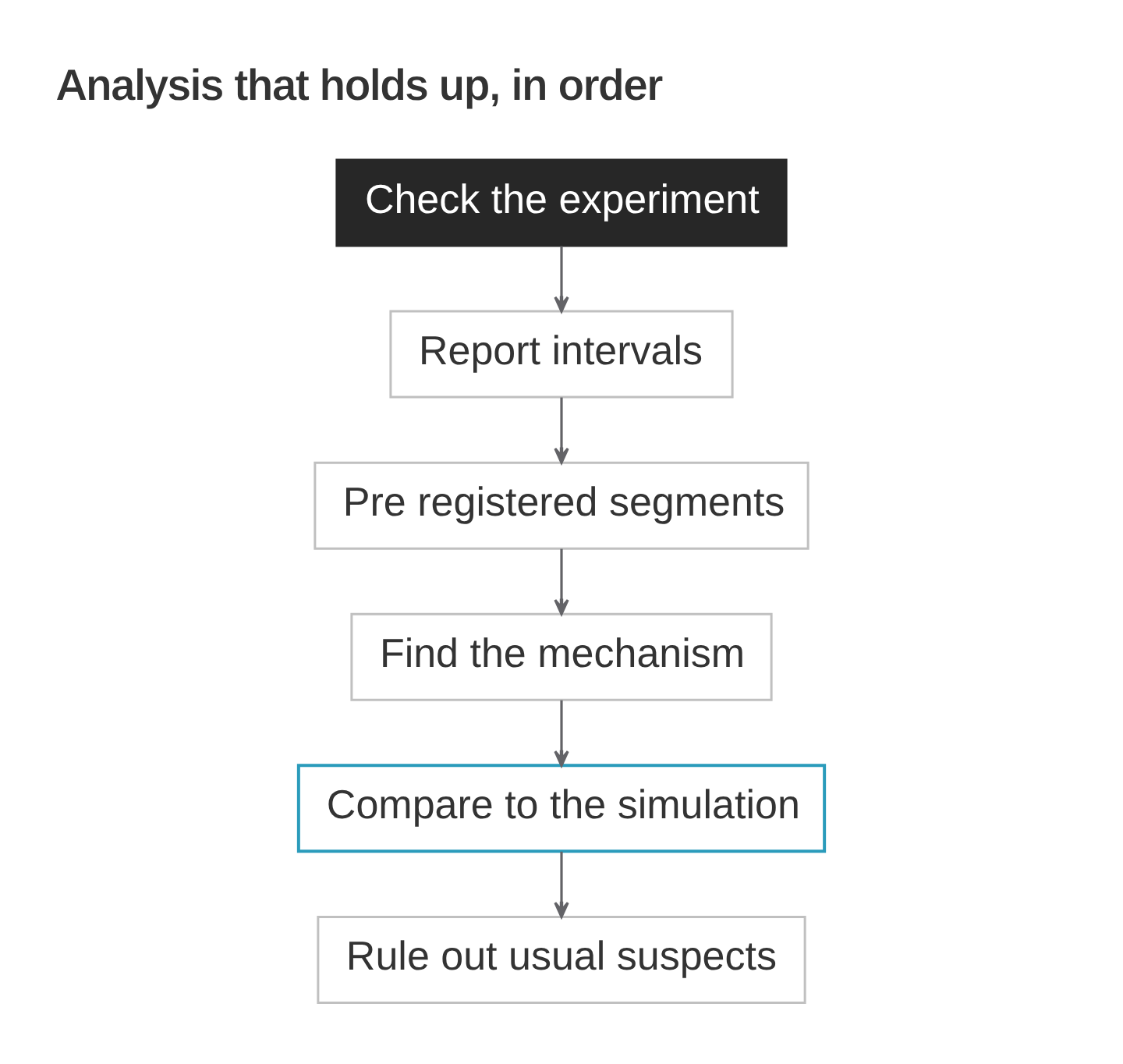
Analysis that holds up
Check the experiment before the idea
Before concluding anything about the idea, check that the test was valid:
- Sample ratio mismatch. If the split was meant to be 50/50 and came out 54/46 (illustrative numbers), assignment was broken. A chi-squared test on group sizes catches this.
- Exposure. Did the treatment group actually experience the change?
- Contamination. Did control units receive the change through another path?
- Power. Could the test have detected a realistic effect? A null from an underpowered test means "unknown", not "no effect".
SRM check: chi2 = sum (observed - expected)^2 / expected over groups
if p < 0.001: invalidate result, investigate assignment
Report intervals, not verdicts
"Conversion fell 0.4 points, 95 percent interval from minus 1.1 to plus 0.3" (an illustrative result) is more useful than "it didn't work". The interval tells the next person what range of effects is ruled out.
Look at segments, carefully
Effects often differ by segment. Report pre-registered segments. Treat segments found after the fact as hypotheses for the next test, not conclusions, because with enough slices something will look significant by chance.
Find the mechanism
Numbers say what happened. A mechanism says why. Look at intermediate steps: did the routing change slow first response, and did the slower response explain the lower meeting rate? Mechanisms transfer to future decisions; isolated results don't.
Compare to the simulation
If the change was simulated first, compare the prediction with the result. (Simulating buyers without fooling yourself covers what a trustworthy simulation looks like.) A large miss is a finding about the simulator, and it should be written up too.
Rule out the usual suspects
Three effects explain many surprising results. Regression to the mean: changes are often launched after a bad week, and the following weeks look better whatever you did, which is one more reason to compare against the control group and not the prior period. Novelty and learning curves: a new email format can lift engagement briefly and fade, while a new rep workflow can dip before people learn it, so plot the effect over time instead of reporting one average. Interference: if treatment and control share reps, budget or a queue, treatment can borrow capacity from control and inflate the difference. Check each before writing the analysis.
Blameless, specific, actionable
Blameless does not mean vague. Name the decision, the evidence available at the time and the gap. "We set the threshold without checking AE capacity" is specific and blameless. Follow-ups must be concrete, owned and tracked, such as "add AE utilization as a required guardrail for routing changes."
Build the library
The value compounds when postmortems are searchable. Tag each by funnel stage, lever, segment and classification. Before proposing a change, search the library. A team with fifty honest postmortems makes better proposals than one with fifty wins on slides.
Why we publish the method
We publish how we run and write up changes, not customers' results. Three reasons:
- It makes our claims checkable. If we say a change worked, you should know how we would have found out if it didn't.
- It sets expectations. Many changes will not work. A process that records nulls and negatives is a process that learns.
- It raises the bar. Results reported without design, control group or intervals are hard to trust. Publishing the method invites the same scrutiny of our own work.
How Surface approaches it
In a Surface, changes are proposed with a hypothesis, tested in Sims, and confirmed with live experiments against a control group, so what was expected can be compared with what happened. Every scenario and run is saved in Vault with its inputs and result, which is the record a postmortem starts from.
The takeaway
Write postmortems for business changes that don't work. Classify the failure, copy the hypothesis and design from before launch, validate the test before judging the idea, report intervals, find mechanisms, compare against simulation, and keep a searchable library.