Research · September 29, 2026 · 5 min read · By Surface Labs team
Simulating buyers without fooling yourself
Synthetic buyer journeys rank options well and forecast badly. The checks that catch overfitting, leakage and feedback loops before you act on one.
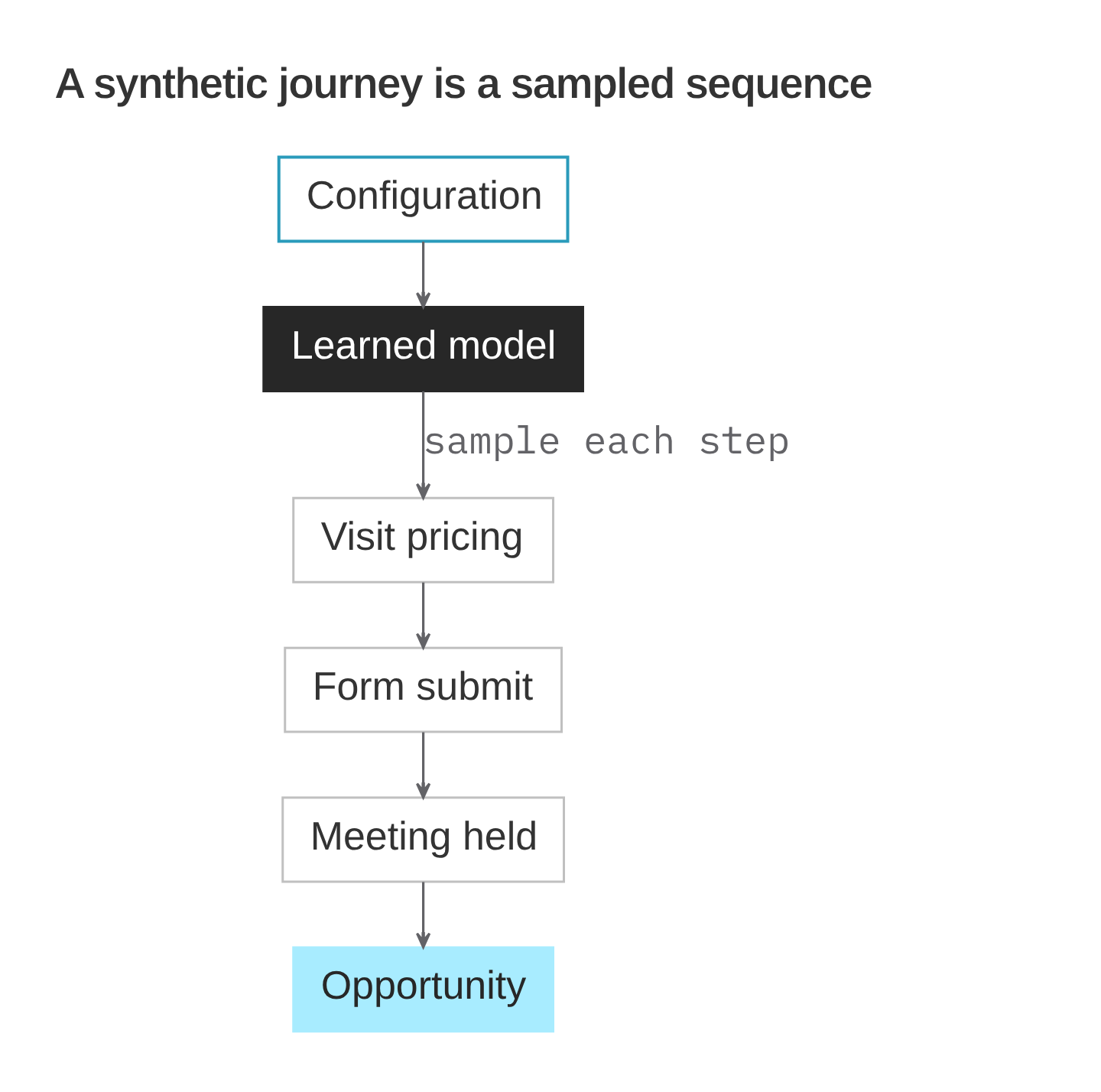
A simulated buyer is not a buyer. It is a sample from a model of how buyers like this one have behaved in the past. That distinction sounds pedantic until a team ships a pricing page because a simulation said it would lift conversion, and it doesn't.
Simulation is one of the most useful tools a go-to-market team can have and one of the easiest to misuse. This post covers what synthetic buyer journeys are good for, where they fail, and the specific checks we run to keep a simulation honest.
What a synthetic journey is
A synthetic journey is a sequence of events generated for a simulated person or account:
visit(pricing) -> form_start -> form_abandon -> retarget_impression -> visit(case_study) -> form_submit -> routed(owner=AE_3, latency=4m) -> meeting_booked -> meeting_held -> opportunity(stage=2)Each step is sampled from a conditional distribution learned from historical data, the entity-level transition model described in Modeling a go-to-market team as a system:
P( next_event | history_so_far, attributes, current_configuration )Change the configuration, for example a shorter form or a different routing rule, and the sampled journeys change. Aggregate thousands of them and you get a distribution of outcomes under each configuration.
What simulations are good for
Ranking options, not predicting levels. The most reliable use of a simulation is comparative: is option A likely better than option B, and by roughly how much relative to the noise? Absolute forecasts ("this will produce 412 meetings", to use an illustrative figure) inherit every bias in the model. Relative comparisons cancel many of them, because both arms share the same model errors.
Finding failure modes. Simulations are good at stress: what happens to response times if inbound triples, or if two reps go on leave in the same week. Edge cases that are rare in history can be constructed on purpose.
Narrowing the experiment space. Live tests are slow and expensive. A simulation can prune ten candidate changes down to two worth testing against a control group.
Where they fail
Out of distribution. A model learned from history can only interpolate. A new market, a new price point or a new channel is outside the data. The simulation will still produce confident numbers. They mean little.
Behavior that depends on things you don't observe. If buyers respond to a competitor's launch, a news cycle or word of mouth that your data never captured, the model attributes the effect to whatever it can see.
Strategic response. Buyers and competitors react. A discount simulated in isolation ignores that competitors may match it.
Why most simulations lie
The failures above are limits. The more dangerous problems are bugs that make a simulation look better than it is.
Overfitting
A transition model with enough features will fit historical journeys almost perfectly and generalize badly. In a simulation this shows up as suspiciously precise differences between options. The fix is the same as in any supervised learning problem: fit on one time window, evaluate on a later one, and penalize complexity.
train window: months 1..9
validate window: months 10..12 (never seen during fitting)
metric: calibration error on P(next_event) and on aggregate outcomes
Leakage
Leakage is when the model is allowed to see information at simulation time that would not have been available at decision time. Classic examples in go-to-market data:
- A "lead score" field that was backfilled after the deal closed.
- Opportunity stage used as a feature for predicting whether a meeting is held.
- CRM fields edited by reps weeks later, read as if they were known on day one.
Leakage produces simulations that are uncannily accurate on history and useless going forward. The check is point-in-time correctness: every feature must be reconstructed as of the moment the decision was made.
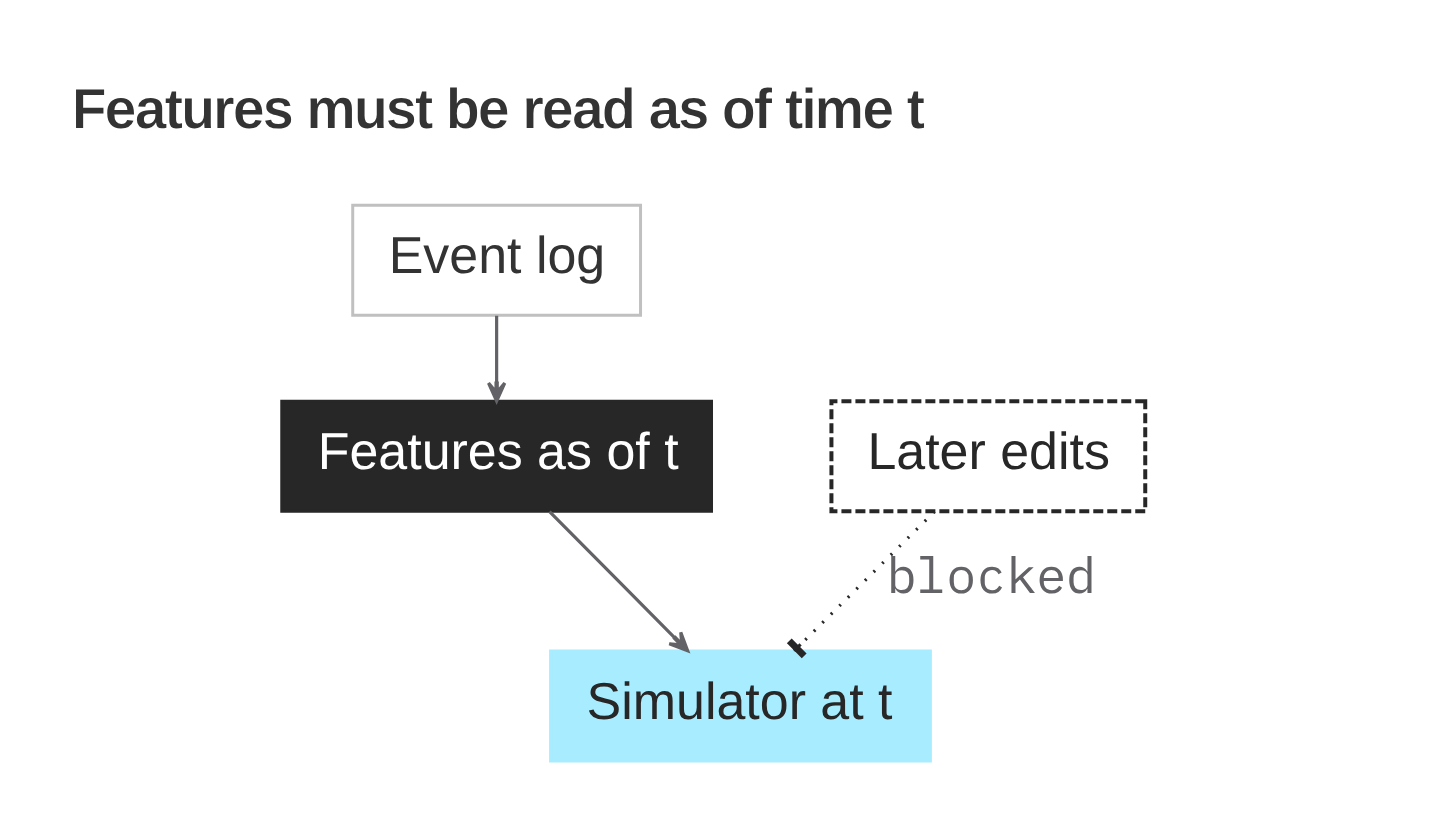
def features_as_of(entity_id, t): # read from the event log, never from current-state tables return event_log.replay(entity_id, until=t).project(FEATURES)Feedback loops
If a team acted on last quarter's simulation, then this quarter's data reflects the simulation's recommendations. A model retrained on that data learns its own past outputs. Over time it becomes more confident and less correct. Keeping a record of which decisions were model-driven, and weighting or separating that data, breaks the loop. So does keeping a control group that the model's recommendations never touch.
The checks we run
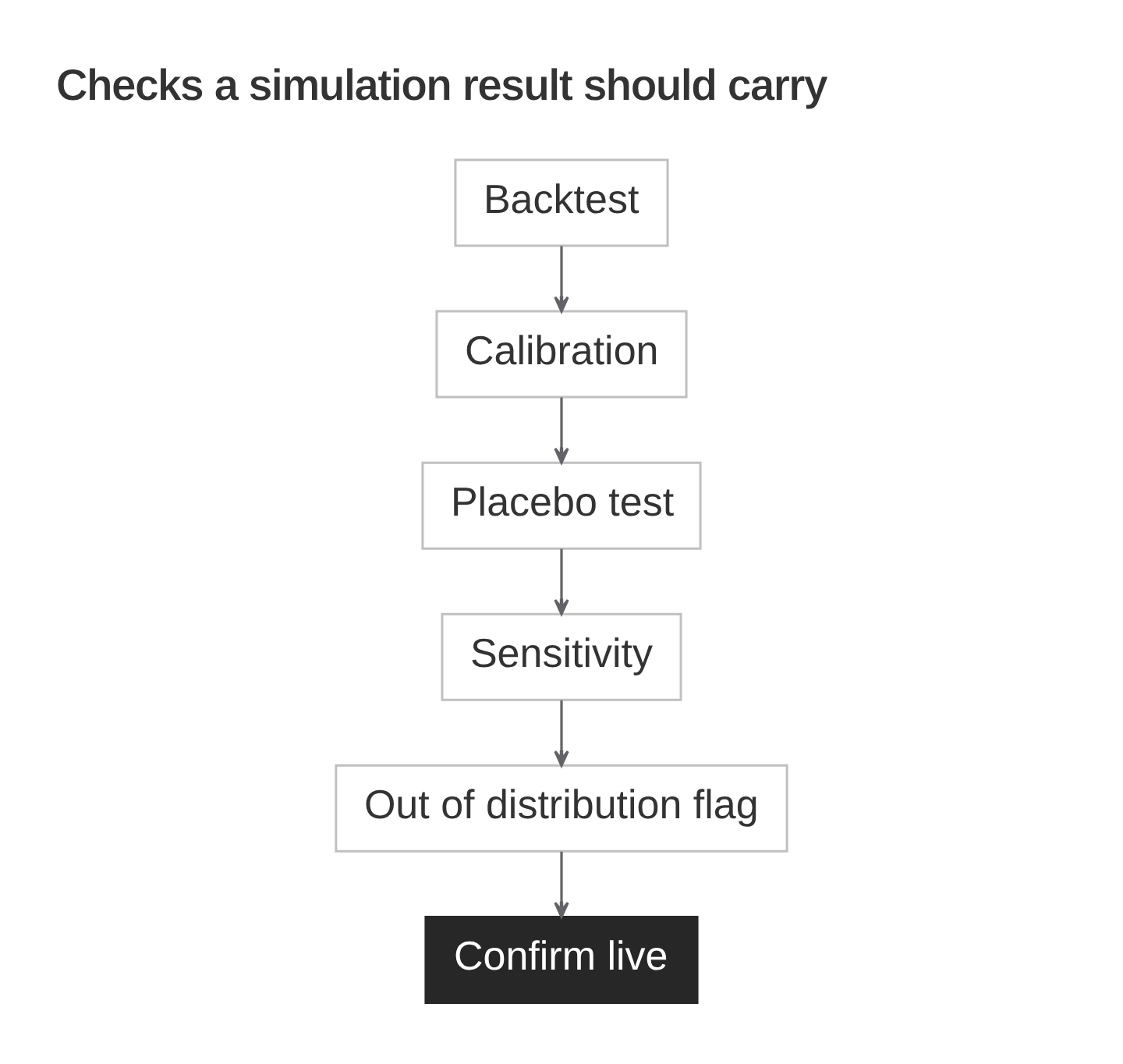
A simulation result should be presented with its evidence. The checklist:
- Backtest. Re-run the simulator on a past period using only data available at its start. Compare simulated and actual outcomes. If the simulator could not reproduce the past, it should not be trusted with the future.
- Calibration. For each transition model, bucket predictions and compare predicted to observed rates. A model that says 30 percent should be right about 30 percent of the time.
- Placebo test. Simulate a change that should do nothing, such as renaming a field. If the simulator reports a meaningful effect, something is leaking.
- Sensitivity analysis. Perturb key assumptions and see whether the ranking of options flips. Rankings that flip under small perturbations are not decisions; they are coin tosses.
- Out of distribution flag. Measure how far the proposed configuration is from anything seen in training, and say so in the result.
- Confirm live. Any change that matters goes to a live experiment against a control group before it becomes the default.
How Surface approaches it
In Surface, simulations run in Sims against the team's own history held in Vault. A simulation result is a starting point for a decision, not the decision itself. Changes that look good in simulation can then be confirmed with a live experiment against a control group. Each simulation returns a forecast with confidence bands, and each experiment's actuals are scored against the forecast so the model is recalibrated where it missed.
The takeaway
Use simulated buyers to rank options and find failure modes. Do not use them as forecasts. Check for overfitting with time-split validation, check for leakage with point-in-time features and placebo tests, break feedback loops with control groups, and confirm anything important live.