Research · October 19, 2026 · 4 min read · By Surface Labs team
Learning from your data without training on it
Improving one company's decisions without putting its data in model weights: retrieval, per-customer models, calibration and private evals.
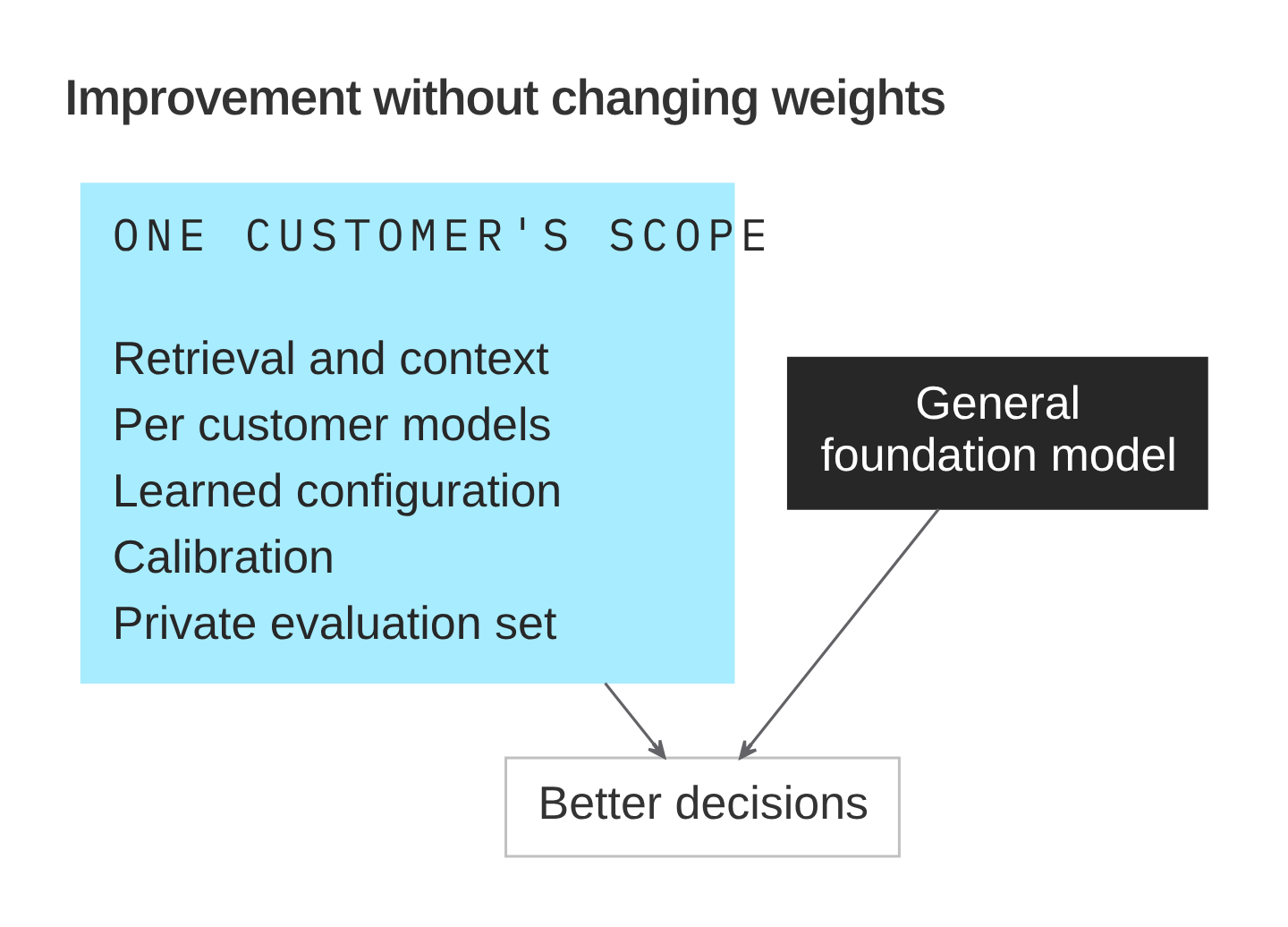
There is a real tension in applied AI for business. Systems get better with data, and the most useful data is a company's own history: which leads became customers, which offers worked, which campaigns created incremental pipeline. Companies are right to be wary of handing that history to a vendor that folds it into a shared model, where it could influence what other customers see or be extracted later.
Surface never trains models on customer data. This post explains how a system can still improve for each customer without doing so, and where the limits are.
Why not training matters
When data is used to update model weights, three things happen that are hard to reverse:
- It persists. Removing one customer's influence from trained weights is an open research problem. Deleting the source data does not delete what the model learned.
- It can leak. Models can memorize and reproduce training examples, especially rare strings like names, emails or deal details.
- It mixes. A shared model trained on many customers' data carries patterns from one into recommendations for another.
Keeping customer data out of training avoids all three by construction.
Where improvement actually comes from
For go-to-market decisions, most of the gain from a company's data does not require changing a model's weights. It comes from using the data at decision time.
Retrieval and context
The simplest and strongest lever: give the model the right facts when it acts. The customer's history, their definitions, their past decisions and outcomes, retrieved per task from that customer's store.
decision = model( task, context = retrieve(customer_store, task) )The model is general. The context is specific. The data stays in the customer's store and is used only for that customer's tasks.
Per-customer statistical models
Many decisions are better served by small statistical models than by language models: the probability that a lead books a meeting, the response curve of a channel, the completion curve of conversions. These can be fit on one customer's data, stored with that customer, and used only for them.
p_meeting = logistic( theta_customer . features(lead) )
theta_customer fit on customer history only, stored in customer scope
This is learning from data in the classical sense, but the parameters belong to that customer's environment, are not shared, and can be deleted with it. They are not foundation model training.
Configuration learned from outcomes
Thresholds, routing weights, approval levels and budget step sizes can be tuned from measured outcomes, including live experiments against a control group. The output is configuration, which is human readable and reviewable.
Calibration
A general model's confidence can be recalibrated against one customer's outcomes, for example with isotonic regression or temperature scaling, so that a stated 70 percent means 70 percent for this business.
Evaluation sets
A customer's past decisions and outcomes can form a private evaluation set used to compare prompts, tools and policies for that customer. Evaluation reads the data. It does not train on it.
Isolation
None of this works without strict separation:
- Each customer's data and derived artifacts live in their own scope.
- Retrieval is filtered by customer at the storage layer, not by asking the model to ignore other customers.
- Per-customer models and configuration are stored and deleted with the customer.
- Logs used for debugging are scoped and retained under policy.
- Model providers should be used under terms that prohibit training on submitted data.
request(customer=c) -> retrieve(scope=c) -> per_customer_models(scope=c) -> foundation_model(no training)What about learning across customers?
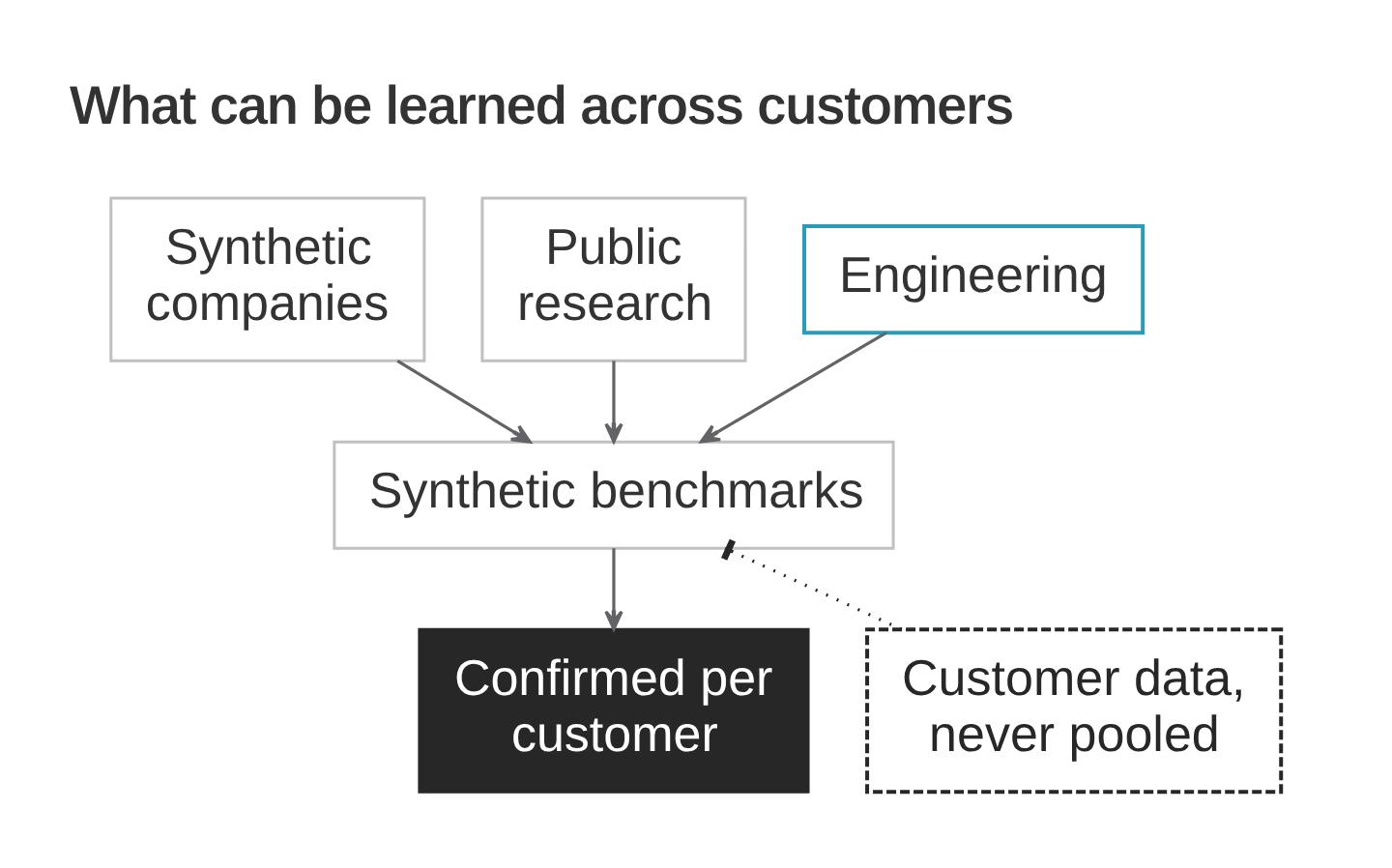
Some improvements genuinely benefit from many examples, such as better general reasoning about routing or budget allocation. Those can come from sources that are not customer data:
- Synthetic companies generated to have realistic structure without real records.
- Public data and published research.
- Engineering improvements to prompts, tools and policies, validated on synthetic benchmarks and then confirmed per customer on that customer's own evaluation set.
The limits
Not training has costs. A system that cannot pool data learns some patterns more slowly, and a brand new customer with little history starts with general behavior until their own data accumulates. We think the trade is right for business data, and the levers above recover much of the gap: good retrieval, small per-customer models, calibration and experiments.
How to evaluate a vendor's claim
If a vendor says they do not train on your data, ask:
- Are prompts and outputs retained? For how long, and who can access them?
- Do model providers have a contractual no-training commitment?
- Are per-customer models or embeddings shared across customers?
- Can you delete everything, including derived artifacts?
- Is isolation enforced in storage, or in prompts?
How Surface approaches it
Surface never trains on customer data. A customer's history is held in Vault for that customer, and improvement comes from using it at decision time and from live experiments against a control group. A customer's model learns from that customer's results only, and is never used to improve the platform for other customers.
The takeaway
You can make a system much better at one company's decisions without putting that company's data into a model's weights. Use the data at decision time, fit small models and configuration in the customer's own scope, calibrate and evaluate privately, and get cross-customer improvement from synthetic and public data instead.