Engineering · October 20, 2026 · 5 min read · By Surface Labs team
Shipping a process change like a software release
Routing rules, offers and budget policies are code in all but name. Versioning, replay, simulation, staged rollout and rollback for process changes.
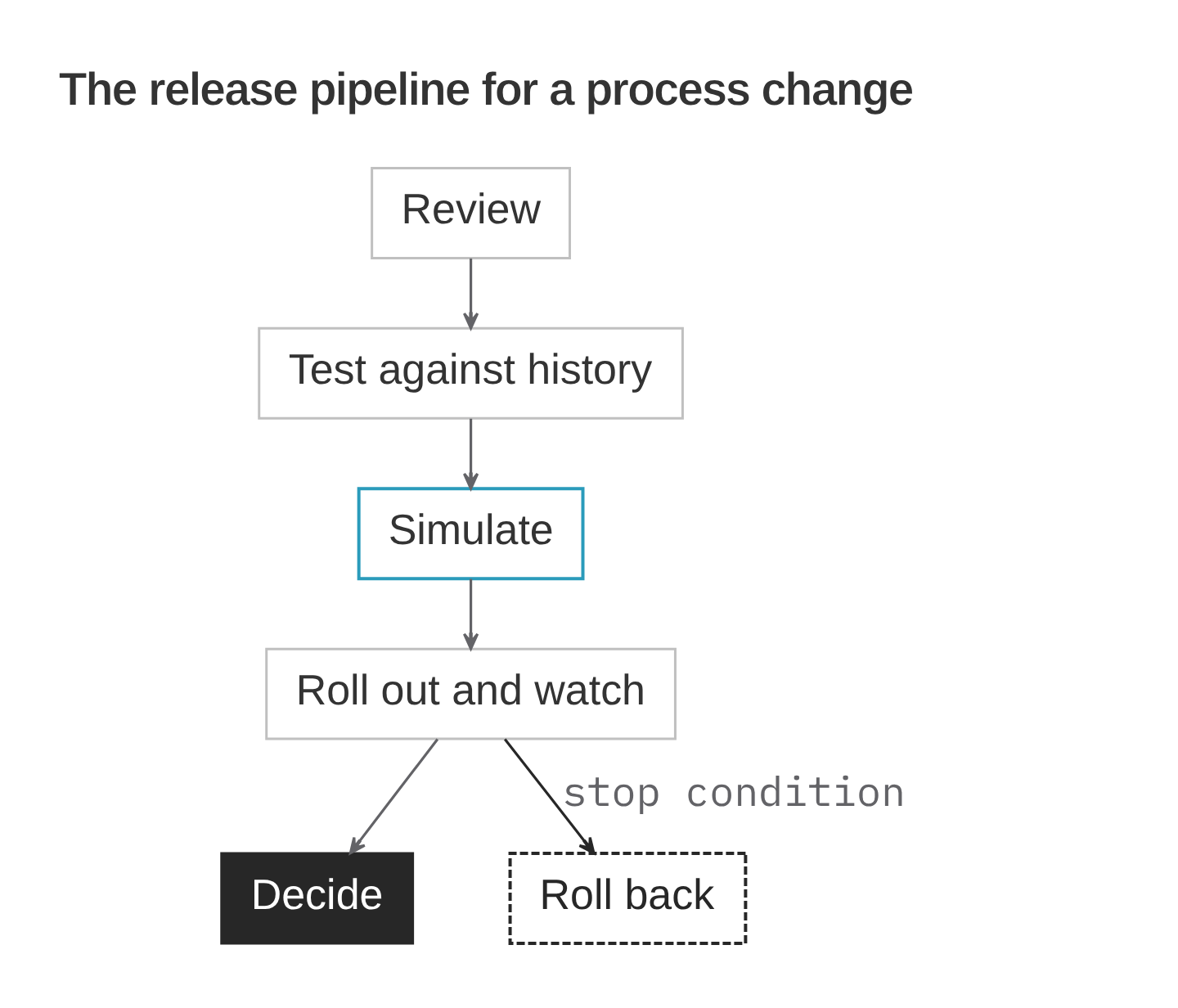
Engineering teams learned, painfully, that changing production directly is a bad idea. Changes go through review, run in staging, roll out gradually, get watched closely and can be rolled back in minutes.
Go-to-market teams change production all the time with none of that. A new routing rule goes live on Monday morning. A lead scoring threshold is edited in place. An offer changes on the pricing page because someone had a good idea. When results move, nobody can say whether the change caused it, and undoing it means remembering what it was before.
Business process changes are code in all but name. They deserve the same release discipline.
What counts as a release
Anything that changes how the operation behaves:
- Routing rules, territories and round-robin pools.
- Scoring models and qualification thresholds.
- Form fields, offers and page copy.
- Sequences, cadences and suppression rules.
- Budget allocation policies and bid strategies.
- Approval thresholds for agents.
Each of these should be represented as versioned configuration, so a change is a diff. The thresholds in this post's examples are illustrative.
 routing:
- - when: employees >= 500 -> pool: enterprise_ae
+ - when: employees >= 300 -> pool: enterprise_ae - else -> pool: smb_ae
The pipeline
1. Review
Every change has an author, a reason, an expected effect and a named metric. Writing down the expected effect before shipping is the single most useful habit, because it makes later evaluation honest.
change: lower enterprise threshold to 300 employees
expect: +meetings held for 300-499 band; no drop in AE meeting rate
metric: meetings_held per qualified lead, AE utilization
guardrails: AE response time p90, SMB pool queue length
2. Test against history
Replay recent real events through the new configuration and compare decisions with the old one. This catches errors in the rule itself: leads that would now go nowhere, pools that would double in size.
for event in last_30_days: old = decide(event, config_v12) new = decide(event, config_v13) if old != new: record(event, old, new)
summarize(diffs by segment)
3. Simulate
Decision diffs show what changes. Simulation estimates what happens as a result: queue lengths, response times, meetings, with uncertainty. (Simulating buyers without fooling yourself covers how to keep that estimate honest.) If the simulation predicts a guardrail breach, fix the change before it ships.
4. Roll out gradually
Expose a fraction of traffic to the new configuration and keep the rest as a control group. Randomize at the right unit: lead, account or region.
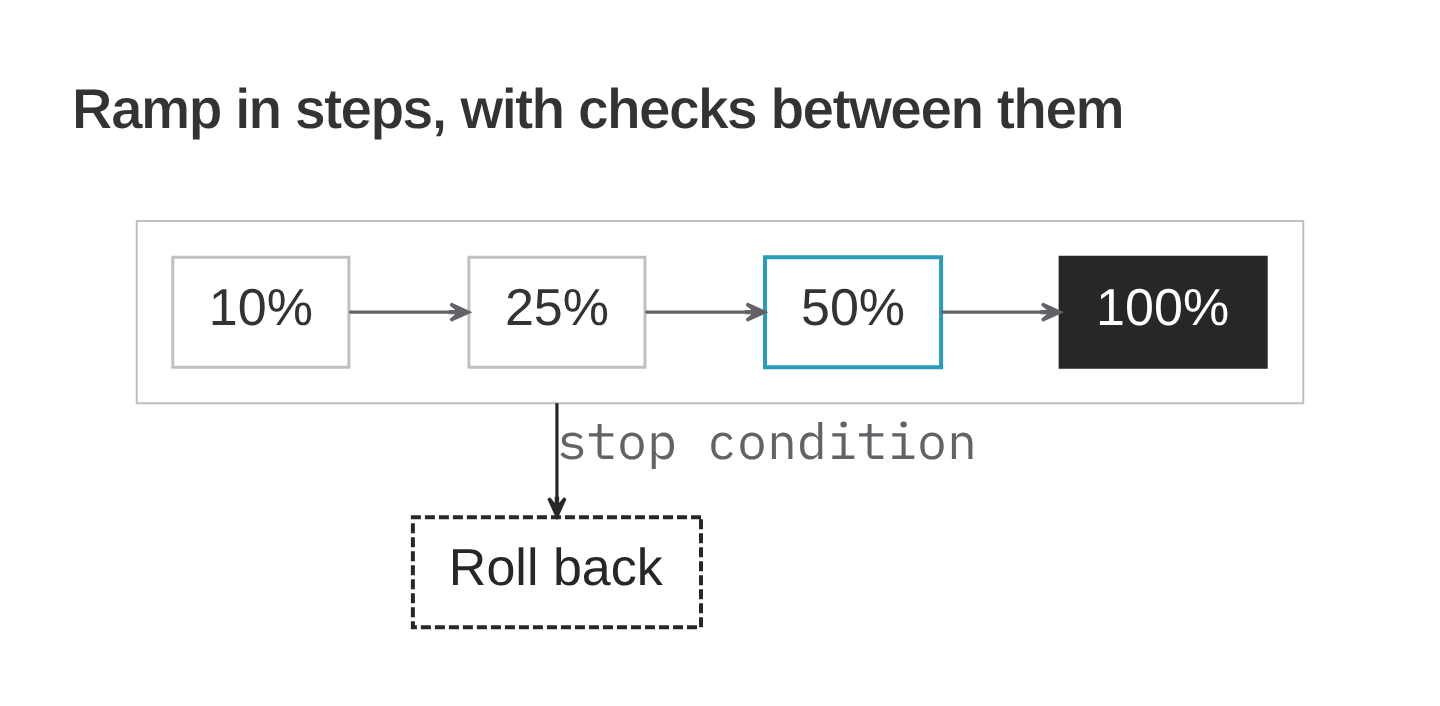
def config_for(unit_id, rollout_pct): bucket = hash(unit_id + change_id) % 100 return NEW if bucket < rollout_pct else OLDRamp in steps, for example 10, 25, 50, 100 percent, with a minimum dwell time at each step and checks before advancing.
5. Watch guardrails
While ramping, monitor the guardrail metrics continuously and compare treatment to control. Define automatic stop conditions in advance. The thresholds below are illustrative.
stop if treatment.response_time_p90 > control.response_time_p90 * 1.25
stop if treatment.queue_length > capacity_limit
6. Decide
At full exposure or at the planned end, compare the named metric between treatment and control with an interval, not just a point estimate. Ship, revert or iterate. Record the decision and the evidence.
7. Roll back cleanly
Rollback should be one action that restores the previous version. It should also handle in-flight work: leads routed under the new rule may need to stay where they are, because reassigning mid-conversation is worse.
The peeking problem
Ramp decisions mean looking at results repeatedly. If every look uses the same fixed significance threshold, the chance of declaring a false win grows with each look, because noise eventually crosses any fixed line. Two ways to stay honest: fix the decision points in advance and spend the error budget across them (alpha spending), or use a sequential test built for continuous monitoring. Guardrail stops are different. They can fire at any time, because stopping for harm does not need the evidence that shipping for benefit does.
looks planned: k = 4 (one per ramp step)
ship only if: p < alpha_spent(look_i) # stricter at early looks
stop at any time: guardrail breached
Leading versus lagging metrics
Process changes often affect slow outcomes such as revenue. You cannot wait two quarters at each ramp step. Use leading indicators with a known relationship to the outcome, such as meetings held or opportunities created, for ramp decisions, and keep measuring the lagging outcome afterward.
Change freezes and conflicts
Two changes affecting the same funnel at the same time make each other unmeasurable. Keep a change calendar, avoid overlapping changes on the same metric, and freeze before events that will distort results, such as end of quarter or a major launch.
Who can ship what
Not every change needs the full pipeline. Classify by risk: copy edits might need review and a quick rollout; routing and budget policies need simulation, gradual rollout and a control group. The same risk and reversibility thinking used for agent approvals applies to people's changes too.
How Surface approaches it
In a Surface, rules and policies can be tested in Sims against the team's own history before they go live, then rolled out as live experiments against a control group. Each result is measured against the control group before the change becomes the default.
The takeaway
Treat process changes as releases. Version them, write down the expected effect, test against history, simulate, roll out gradually against a control group, watch guardrails with automatic stops, decide on evidence and keep rollback to one step.