Research · October 2, 2026 · 5 min read · By Surface Labs team
Evaluating agents on decisions, not conversation
Chat benchmarks say little about whether an agent should touch a budget or a lead queue. How to build evaluations that score decisions by outcome.
Most public evaluations of language models measure things like question answering, coding or how humans rate a response. Those are reasonable proxies for a chat assistant. They are weak proxies for an agent whose job is to move budget, route a lead or decide which offer a returning customer should see.
An agent working inside a go-to-market team is making decisions with consequences. The right evaluation scores the decision by its outcome, not the prose around it.
Why chat quality is the wrong target
A fluent explanation of why budget should move from campaign A to campaign B is not evidence that the move is correct. Three problems compound:
- Plausibility is not correctness. Models are good at producing reasons. Reasons for a bad decision read just as well as reasons for a good one.
- Single-turn grading misses sequential effects. A routing decision affects rep capacity, which affects the next hundred routing decisions. Grading one response at a time cannot see that.
- Human preference ratings reward confidence. Raters tend to prefer decisive answers, which pushes agents away from saying "I don't have enough data" when that is the right answer.
What a decision benchmark looks like
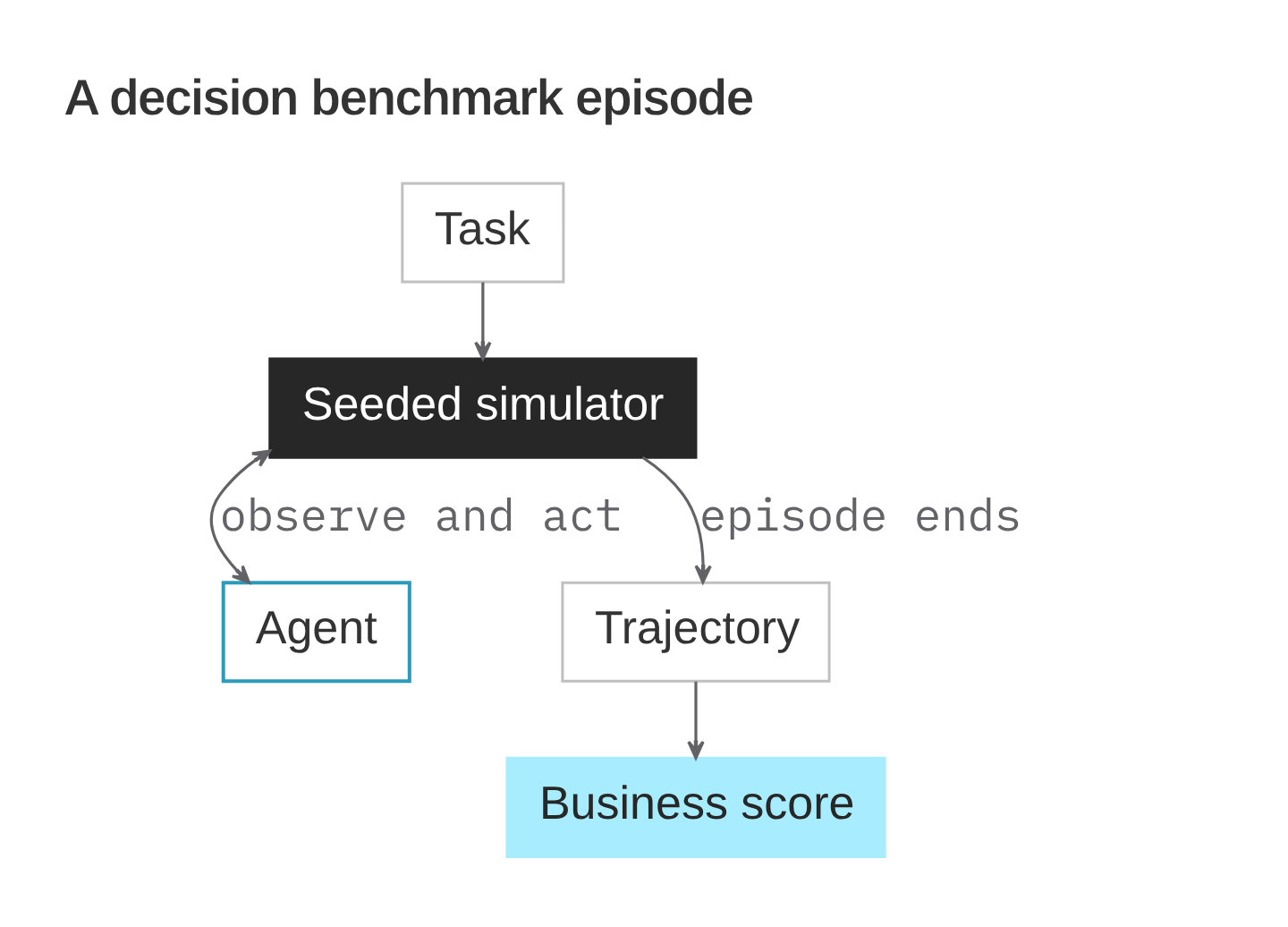
A decision benchmark is closer to a reinforcement learning environment than to a quiz. Each task has:
- An initial state. A snapshot of accounts, leads, campaigns, budgets and capacity.
- An action space. The tools the agent may call: move budget, assign an owner, send an offer, escalate to a person, do nothing.
- Dynamics. A simulator that advances the state in response to actions.
- A scoring function. Defined in business terms, computed after the episode ends.
def run_episode(agent, task, seed): env = Simulator(task.initial_state, seed=seed) while not env.done(): obs = env.observe(visible_to=agent.role) action = agent.act(obs, tools=task.allowed_tools) env.step(action) return task.score(env.trajectory())Scores are things like:
budget task: incremental conversions per dollar, minus penalty for overspend
routing task: meetings held, minus penalty for SLA breaches and misroutes
offer task: margin-adjusted revenue, minus penalty for policy violations
Every task should also have an "abstain" option with its own score, so an agent that correctly escalates is rewarded rather than punished.
Designing tasks that discriminate
A benchmark is only useful if it separates good decision makers from bad ones. Some principles we follow:
Include traps. Tasks where the obvious action is wrong: a campaign with high platform-reported conversions and no incremental lift, a lead whose email domain matches a target account but who is actually a student. Agents that pattern match fail these.
Include missing information. Tasks where the correct move is to ask, wait or escalate. These test calibration.
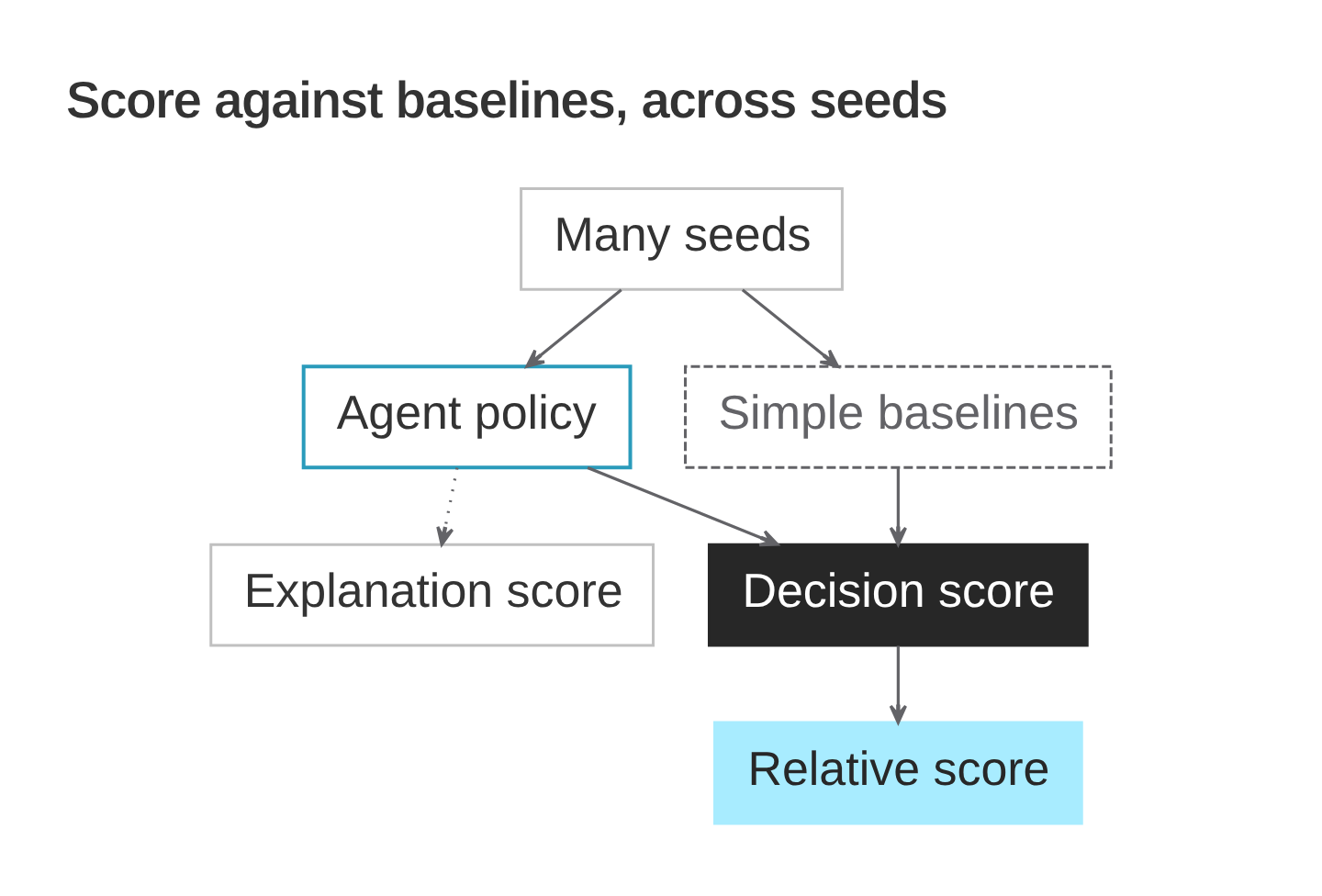
Vary the seed. Run each task across many random seeds so a lucky outcome does not score as a good decision. Report the mean and the spread.
Score against baselines. Compare each agent with simple policies: do nothing, a fixed rule, a greedy heuristic. An agent that cannot beat "do nothing" on a budget task should not be moving budget.
score_relative = (score_agent - score_baseline) / |score_baseline|Separate the decision from the explanation. Grade the action. Grade the explanation separately, for faithfulness to the data the agent actually saw, not for persuasiveness.
Data: synthetic and public only
Benchmarks for business decisions are hard to publish because real business data is private. We build ours on synthetic companies and public data only. Synthetic companies are generated with realistic structure, such as skewed account sizes, seasonal demand, long B2B cycles and noisy CRM fields, but contain no customer records. That keeps the benchmark shareable and avoids any question of leaking customer information.
The tradeoff is realism. A synthetic environment can be gamed by an agent that learns its quirks. Rotating environment generators and holding back unseen task families for final evaluation reduces that risk.
Scoring calibration
Agents state confidence, either explicitly or by choosing whether to act. That confidence can be scored. When the agent reports a probability, such as the chance a lead books a meeting, a proper scoring rule like the Brier score rewards accuracy and honest uncertainty at the same time. For act or abstain choices, plot accuracy against the share of tasks the agent chose to act on. A well calibrated agent gets more accurate as it acts on fewer, easier tasks.
brier = mean( (p_predicted - outcome)^2 ) # lower is betterContamination and overfitting to the benchmark
Any fixed benchmark eventually leaks into training data or into prompt engineering. Defenses:
- Keep a private evaluation split that is never used for tuning.
- Generate fresh task instances from templates for each evaluation run.
- Track performance on old versus new instances; a widening gap means overfitting.
From benchmark to production
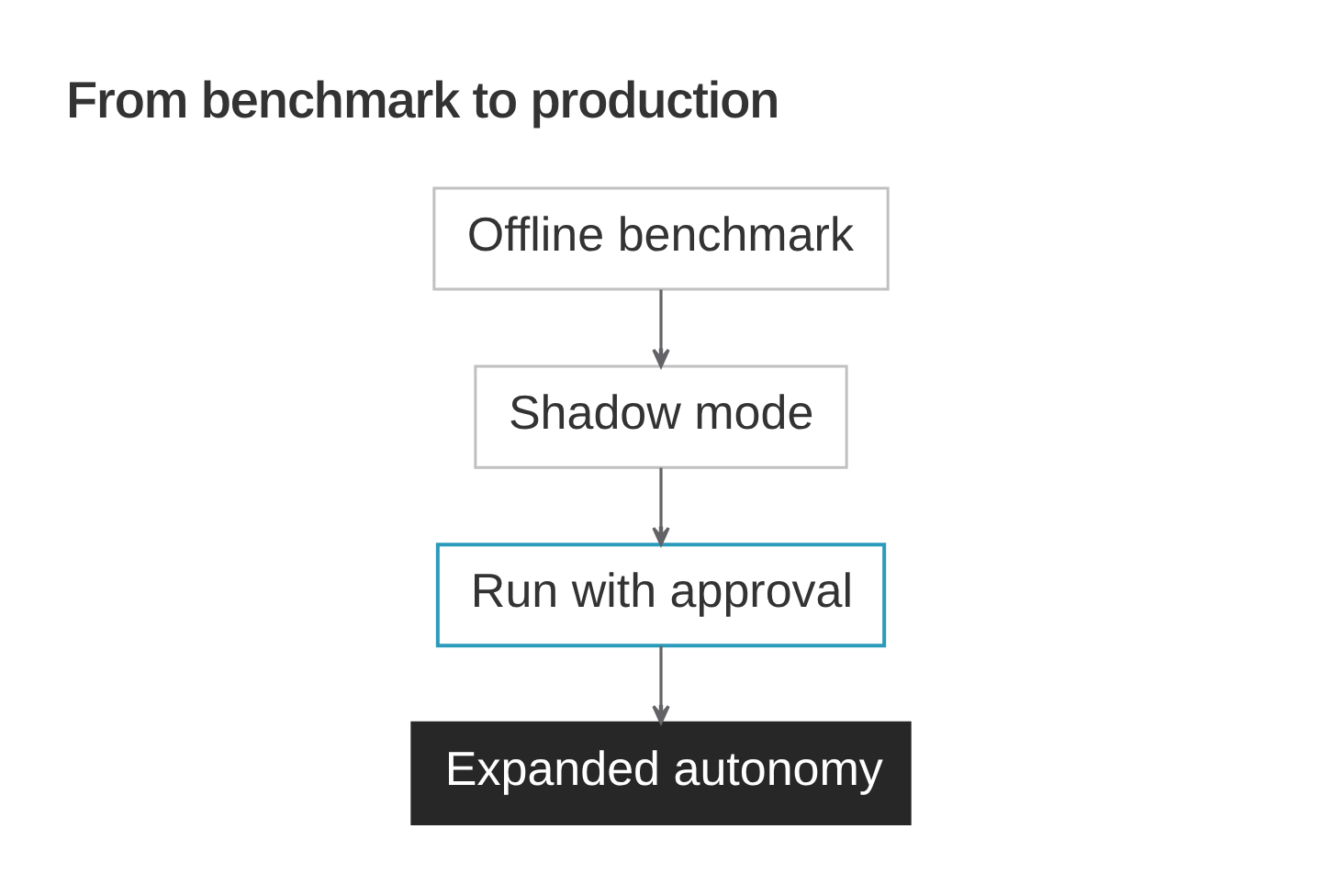
A benchmark score is a gate, not a guarantee. The path we recommend:
- Pass the offline benchmark against baselines.
- Run in shadow mode: the agent proposes actions on live data, people act, and the proposals are scored after the fact.
- Run with approval: the agent acts after a person approves.
- Expand autonomy for low-risk, reversible actions where the record supports it, and confirm with a live experiment against a control group.
How Surface approaches it
We are building a decision benchmark for go-to-market agents on the principles above, using only synthetic and public data. Inside a customer's Surface, agents are evaluated the same way: by the outcome of the decisions they make in Sims and in live experiments, not by how their messages read. We will share more about the benchmark when it is ready.
The takeaway
If an agent is going to make decisions, measure decisions. Build environments with state, actions and business scores, include traps and abstain options, compare against simple baselines, keep a private split, and move to production through shadow mode and approval steps.